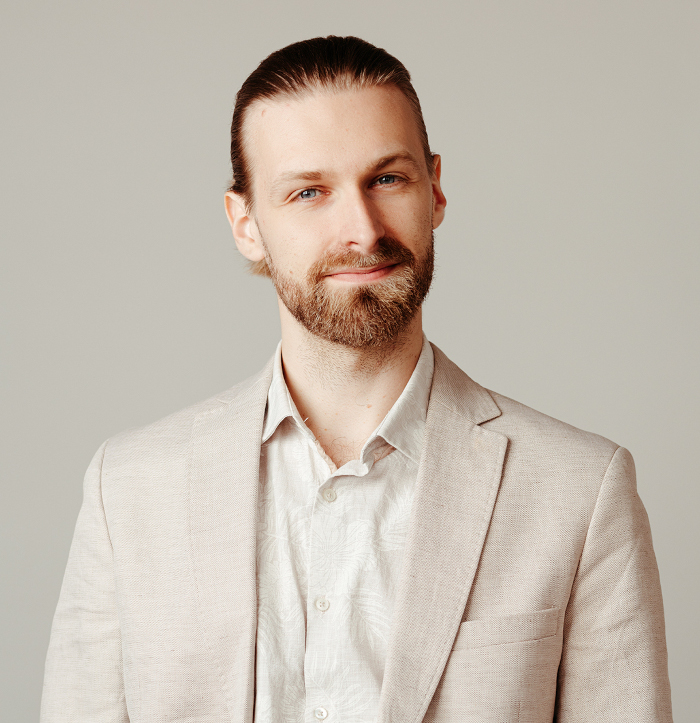
I am an experimental physicist. I have worked on superconducting quantum hardware for more than ten years, in academic labs and in industry. I built quantum processors at IQM and studied what limits qubits at Alice & Bob.
Today I am Founder and CEO of Apex Qubits.
Since June 2026, I have also been a Research Fellow in the Quantum Computing and Devices (QCD) group at Aalto University.
At a glance
| Role | Organization | Dates |
|---|---|---|
| Founder and CEO | Apex Qubits (pre-incorporation) | Since November 2025 |
| Research Fellow, Quantum Computing and Devices (QCD) group | Aalto University | Since June 2026 |
| Staff Engineer | Alice & Bob | August 2024 to January 2025 |
| Technical Project Leader, Qubit Coherence Project | IQM Quantum Computers | August 2022 to March 2024 |
| QPU Design Engineer | IQM Quantum Computers | October 2021 to March 2024 |
| PhD in Physics | CNRS Institut Néel, Université Grenoble Alpes, Grenoble | 2022 |
Current focus: Apex Qubits
Apex Qubits makes superconducting quantum processors, robust by design. Our target is quantum error correction. The same processors serve other research that needs good qubits. To give quantum teams a processor they own, we design, fabricate and test every chip ourselves. Each one will ship as a standalone packaged chip, with its test data and root access. We make the processor. Others build the computer.
Apex Qubits is pre-incorporation. We are funded by grants for now and plan to raise soon. The company site is apexqubits.com, and its news is on the News page.
Expertise
- Superconducting qubits and circuit quantum electrodynamics (circuit QED)
- Qubit coherence: loss channels, two-level systems (TLS), quasiparticles, flux noise, vibration and radiation
- Qubit readout and microwave measurement chains, including nonlinear readout of transmon qubits
- Nanofabrication of superconducting circuits: process tuning and reproducibility
- Cryogenic setups and laboratory specifications
- QPU layout and electromagnetic simulation: KQCircuits, HFSS, Q3D, energy participation ratio (EPR)
Experience
Aalto University, since June 2026
I am a Research Fellow in the Quantum Computing and Devices (QCD) group at Aalto University.
IQM Quantum Computers, October 2021 to March 2024
I joined IQM as a QPU design engineer. I designed and simulated processor layouts of up to about 50 qubits in KQCircuits, and I helped develop the energy participation ratio (EPR) simulation tool. From August 2022, I led the Qubit Coherence Project as technical project leader: about 15 engineers and researchers across design, fabrication and measurement. Over the project, we raised the maximum qubit lifetime (T1) from about 80 µs to about 1000 µs. The work led to 7 patent applications and 22 invention disclosures.
Alice & Bob, August 2024 to January 2025
As Staff Engineer, I led the work on what limits superconducting qubits in the lab: two-level systems, quasiparticles, electromagnetic noise, vibration, radiation and infrared photons. I characterized flux noise in cat qubits. I also wrote the specifications for a new R&D laboratory.
PhD, CNRS Institut Néel, Université Grenoble Alpes
I did my PhD in physics at CNRS Institut Néel, Université Grenoble Alpes, in Grenoble, and completed it in 2022. I built a nonlinear readout platform for transmon qubits. It reached 99.4 % single-shot fidelity, about 6 errors in 1000. In addition, I developed a fabrication recipe that raised the median qubit lifetime (T1).
Recent paper
In 2025, Cyril Mori and I published “High-power readout of a transmon qubit using a nonlinear coupling” with 14 co-authors (arXiv 2507.03642). The full list of papers is on the Publications page.
Point of view
A quantum computer is built from many parts. Almost all of them are sold on the open market. The processor is the exception: the best ones stay inside one vendor’s machine or cloud.
In classical computing, a lab can buy a GPU and build its system around it. I want quantum teams to have the same choice with a processor they own.
That is why I put robust qubits first. At IQM and at Alice & Bob, much of my work was about what limits qubit coherence in a real lab. A team that owns its processor runs it every day, in its own conditions. So the qubits must stay stable by design, and the processor must be built with margin.
Official photographs are available on the dedicated photo page.